Double donation
Siblings give ‘new life’ to sisters with sickle cell.
Article Author: Juliette Allen
Article Date:

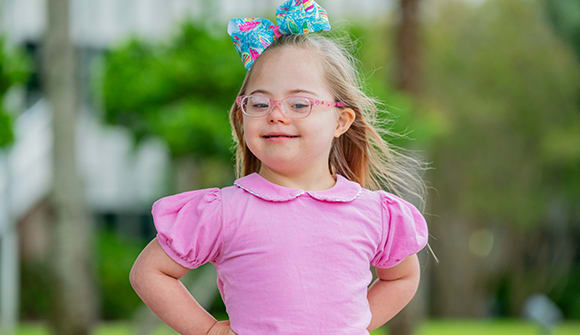
Seventeen-year-old Sani’Yah Johnson and her 7-year-old little sister, Rah’Niyah, have a lot in common. As Sani’Yah hones her skills as a hair stylist, Rah’Niyah also embraces all things beauty and sparkle.
“Rah'Niyah is like a little lady in a baby’s body,” their mother, Ericka Johnson, said. “I have great kids. My children all get great grades.”
The sisters also both received life-changing bone marrow transplants that cured their sickle cell disease. The donors? Two of Johnson’s other children.
“It’s amazing,” Johnson, a mother of six, said. “They got a new life.”
Sickle cell surprise
Just like almost every newborn in the United States, Sani’Yah received a heel-prick blood test while still at the hospital following her birth. Her mother was shocked when, just days later, she received the news that her baby girl had sickle cell disease, a disorder in which the red blood cells lose their flexible shape and instead form a sickle, or crescent moon shape. The affected cells can become hard and sticky, blocking blood flow to critical organs in the body.

Sani’Yah, now 17, received her bone marrow transplant in 2023.
“I knew I carried the sickle cell trait [asymptomatic carrier], but my husband didn’t know that he also had it,” Johnson recalled. A child needs to inherit the gene from both parents in order to have sickle cell disease.
Johnson immediately took baby Sani’Yah to the hematology/oncology specialists with Nemours Children’s Health, Jacksonville, and Wolfson Children’s Hospital. The two organizations have a collaborative Sickle Cell Program that helps families navigate sickle cell disease through comprehensive care and specialized treatment.
Sani’Yah managed to avoid serious complications related to her sickle cell disease for nearly a decade.
“When she was 9 or so, she had acute chest syndrome, which is when the sickled red blood cells stick together and block flood flow in her lungs,” said Johnson. “Then when she was 13, she had a stroke.”
Thankfully, Sani’Yah fully recovered from both incidents. By this point, though, Johnson had given birth to her youngest child, Rah’Niyah, who also had inherited the disease.

Rah’Niyah, now 7, received her bone marrow transplant one year after her older sister.
Sisters helping sisters
Children of parents who both carry the sickle cell trait have a 50% chance of inheriting the trait themselves, and a 25% chance of having the disease.
Currently, the only approved cures for sickle cell disease are bone marrow transplant and gene therapy, the latter of which was just recently approved. While sickle cell disease commonly runs in families, it’s rare to find full transplant matches in the immediate family. Johnson had her whole family tested to see whether they could be potential donors. In the end, two of Johnson’s other daughters, London and Lyn’Niyah, were matches.
“They were all in, 100%,” Johnson remembered. “They knew they were saving their sisters’ lives, but I was also upfront with them that it wouldn’t be an easy process, so they knew what to expect.”
When you have full matches within the family, that is the best form of transplant you can have because the outcomes are much better,” said Edward Dela Ziga, MD, MPH, a pediatric hematologist/oncologist with Nemours Children’s Health, Jacksonville, and director of the Blood and Marrow Transplantation Program, a collaboration among Wolfson Children’s Hospital, Nemours Children’s Health and Mayo Clinic.
Once a match is identified, both the donor and recipient undergo extensive testing to make sure their heart, liver, kidneys and lungs are functioning well enough to tolerate the transplant. According to Dr. Ziga, the recipient receives intense chemotherapy leading up to the transplant to wipe out the sickled cells in the marrow and takes immunosuppressive medications so the body will not reject the donor stem cells.
A day or two before the transplant, stem cells are extracted from the donor. Those cells are then infused through an intravenous (IV) line into the recipient, where they migrate to the bone marrow and start making new, healthy cells.
On June 22, 2023, then-15-year-old Sani’Yah received her bone marrow transplant from then 10-year-old London. Almost exactly a year later, Rah’Niyah, then 6 years old, received the same gift from 12-year-old Lyn'Niyah.
Johnson said both Sani’Yah and Rah’Niyah recovered remarkably well after the transplant, and she could see improvements to their health almost immediately.
Both girls are considered cured. Sani’Yah, who is now a senior in high school, has “graduated” from the Sickle Cell Program. Rah’Niyah’s follow-up appointments continue to be spaced farther apart, now occurring just once every six months.
“I’ve been with Wolfson Children’s and Nemours Children’s for 17 years, so they’re like family to me,” Johnson said, reflecting on the care her family has received for more than a decade. “They did everything to make sure my family was comfortable. Every need we had, it was taken care of.”
As for what the future holds for these two sisters?
“The sky is the limit,” Dr. Ziga said. “They can live their lives without any limitations.”
To learn about services for sickle cell disease or Wolfson Children’s Blood and Marrow Transplantation Center, a collaboration with Nemours Children’s Health, Jacksonville, and Mayo Clinic, click here. Support from the community helps ensure Wolfson Children's patients, like Rah’Niyah and Sani’Yah, have access to the world-class services they need to survive and thrive. To learn more about giving opportunities, click here.