Things can get tricky when you feel icky
Is it a cold, a sinus infection or just allergies? Common symptoms can make it hard to tell.
Article Author: Wesley Roberts
Article Date:

When you think of "cold season," do you envision a crackling fire and hot chocolate or piles of used tissues and empty cough drop wrappers? When you don't feel well, it can be hard to tell if it's just a cold that will pass or if you're facing a sinus infection.
According to the Centers for Disease Control and Prevention (CDC), colds are the leading cause for missed days of work and school in the United States. A cold is a viral infection of the upper respiratory tract and can be caused by one of nearly 200 different viruses, with rhinovirus being the most common.
"Common colds usually improve on their own in less than 10 days," said Justin Moy, MD, an otolaryngologist (ENT) with River City ENT. "The major difference is that a common cold is viral and a sinus infection is bacterial."
Lasting anywhere from two to 12 weeks, sinus infections affect nearly 35 million Americans at least once a year. The sinuses are small, air-filled cavities located in the skull. Normal sinuses contain healthy bacteria, but when the opening to a sinus becomes blocked, causing mucus to build up, bacteria can grow unchecked in the sinuses and cause an infection.
Stopping the sniffles
Colds
"Unfortunately, a cold just has to run its course," said Dr. Moy. "You can mask the symptoms but there is no true 'cure' for a cold. It's normal for a patient to get at least two colds a year."
Over-the-counter remedies to help control symptoms include:
- Taking ibuprofen like Advil ®
- Rinsing nasal cavity with saline solution, with sterile water, using neti pot
- Taking cough suppressants
- Using sore throat lozenges
- Taking guaifenesin like Mucinex ® or Robitussin ®
"Antibiotics prescribed by a doctor will only help if it is a sinus infection. Because colds are viral, antibiotics, which are for bacterial infections, don't help," said Dr. Moy. "It's OK to wait at least 10 to 14 days to see a primary care practitioner with cold symptoms."
Allergies
According to Dr. Moy, most people with allergies will benefit greatly from just using over-the-counter medicines like Zyrtec®, Allegra® and Claritin®. He also recommended nasal sprays like Flonase® and Nasonex ®.
"If you're still not getting better with these allergy medications, it may be time to see an ENT who can determine the next step to take," said Dr. Moy.
Sinus Infections
There are two key factors to determine when a cold (a viral infection) has progressed to a sinus infection (a bacterial infection).
- Ten days of symptoms that are not improving at all can be a sign of a sinus infection. The likelihood of a bacterial infection in the first few days of a cold is very unlikely.
- "Second worsening," which is when symptoms start to improve and then get significantly worse again, this can also be a sign of a bacterial infection.
"These are examples of when it is time to see a doctor," said Dr. Moy. "Your primary care physician will likely prescribe antibiotics. If you've completed two to three rounds of antibiotics and are still having symptoms, the issue lasts more than three months or you're getting a sinus infection more than four times a year, it's time to see an ENT specialist."
Similar symptoms:
- Scratchy throat? Check.
- Sneezing? Check.
- Pressure? Check.
With so many similar symptoms, these differentiating factors can help determine whether you are facing a cold, allergies or a sinus infection.
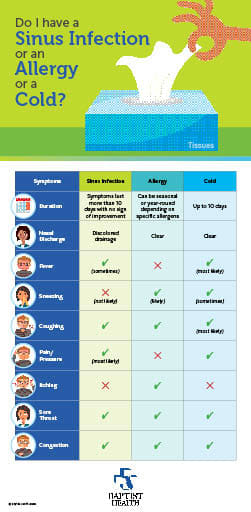
"The best thing you can do to prevent the common cold is to wash your hands thoroughly and frequently," said Dr. Moy. He recommended that people be patient when they have the above symptoms. "Many people think they have a sinus infection after just a few days; wait it out and don't rush to a diagnosis."
Your primary care physician is your first stop when you're not feeling well. To find the right one for you, call 904.202.4YOU (4968) or fill out the appointment request form.