Purpose in the journey
Leadership coach turns breast cancer experience into opportunity to advance cancer research.
Article Author: Wesley Roberts
Article Date:

The day she closed on a new home, Deonna Mathis went to bed feeling excited about what was ahead. Now with adult children and an empty nest, she and her husband of 20 years were both looking forward to life’s next chapter. But as she settled in for the night, she felt a lump in her breast. In an instant, the future she was imagining gave way to uncertainty.
“The lump was about the size of a 50-cent coin,” said Mathis, whose husband was already asleep. “I was standing in the mirror thinking ‘this cannot be happening.’”
The next morning, she told her husband and immediately made an appointment with her gynecologist who got the ball rolling on a mammogram and ultrasound.
Shortly after testing, she received her diagnosis: stage 2B triple-negative breast cancer. This meant the tumor was between two to five centimeters in diameter, but had spread to nearby lymph nodes.
Her gynecologist recommended Baptist MD Anderson Cancer Center for treatment.
“[The gynecologist] told me that at Baptist MD Anderson, everything is right there for me. There’s a team. It’s a one-stop shop,” recalled Mathis, who also appreciated the proximity of Baptist MD Anderson to her workplace. “I knew I wanted to continue working through treatment. I wasn’t going to let cancer define my life.”
The light bulb moment
Her first appointment was with Bharatsinh Gharia, MD, breast medical oncologist at Baptist MD Anderson.
“He stayed with me for 47 minutes to explain all that was about to happen. He drew pictures. I had never had this level of care from a medical professional,” said Mathis.
Her treatment plan involved surgery, chemotherapy and radiation. Along the way, she was offered another opportunity: participation in a clinical trial.
The clinical trial, called “OptimICE-pCR,” is a national research study exploring how immunotherapy can be used most effectively in patients with triple-negative breast cancer.
When presented with the opportunity, Mathis described the decision like a “light bulb” moment.
“I knew what I wanted to do. I could help others. This was my way of giving back to the cancer community,” she said. “If I can lend any information to researchers to make it better for the next women facing a cancer diagnosis, I want to be able to do that.”
“For many patients with triple-negative breast cancer, immunotherapy has become a common part of treatment,” explained Dayra Avila-Lima, MD, breast medical oncologist at Baptist MD Anderson. “The study is asking an important question: If a patient's cancer has a complete response to chemotherapy and immunotherapy, meaning there’s no cancer found in the tissue removed during surgery, do they still need additional immunotherapy afterward? We know that patients who achieve a complete response have an excellent prognosis. The goal is to ensure every patient receives the treatment that's right for them, while reducing unnecessary treatment whenever possible.”
“Patients shouldn't have to choose between innovative cancer treatment and compassionate care,” said Dr. Gharia. “Our goal is to bring those things together. Clinical trials allow patients to access the latest research, while still receiving care from a team dedicated to supporting them throughout their journey.”
New adventures await
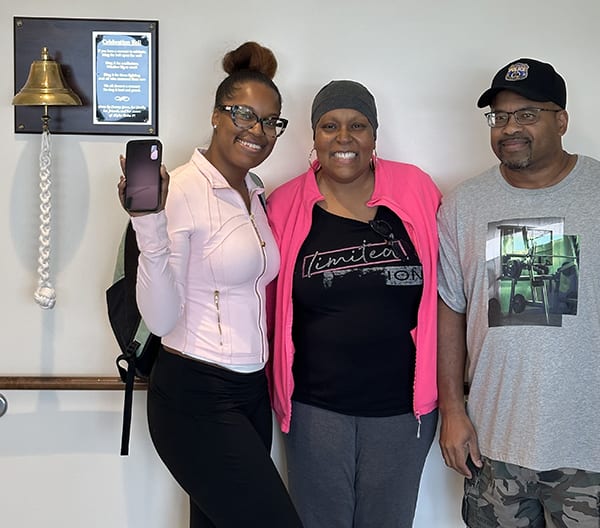
Recently, Mathis completed radiation and is looking forward to having her chemo port removed.
“That will seal the deal that I can truly begin the healing process, both mentally and physically,” she shared, noting that journaling had been a very important part of her overall well-being throughout her cancer journey. “If other people with cancer have the ability to journal, I recommend it. Some days, that just means doodling or writing a list of words.”
She also has exciting plans on the horizon. Next summer, she’s taking a group trip (19 friends and family!) to enjoy time in the mountains of Tennessee and to visit Dollywood.
“It will be a celebration!” she said.
Clinical trials are an important part of how cancer care evolves. At Baptist MD Anderson Cancer Center, patients may have access to clinical trials that explore new treatments, therapies and approaches to care. To learn more about clinical trials or find out whether a study may be right for you or a loved one, visit Baptist MD Anderson’s Research Studies & Clinical Trials.
This trial is conducted by the Alliance for Clinical Trials in Oncology, a national research network that brings together cancer centers and investigators to develop and conduct clinical trials throughout the United States and Canada. The National Cancer Institute (NCI) provides support for the Alliance and its research through the NCI's National Clinical Trials Network.