Need NICU?
When a newborn may require critical care.
Article Date:
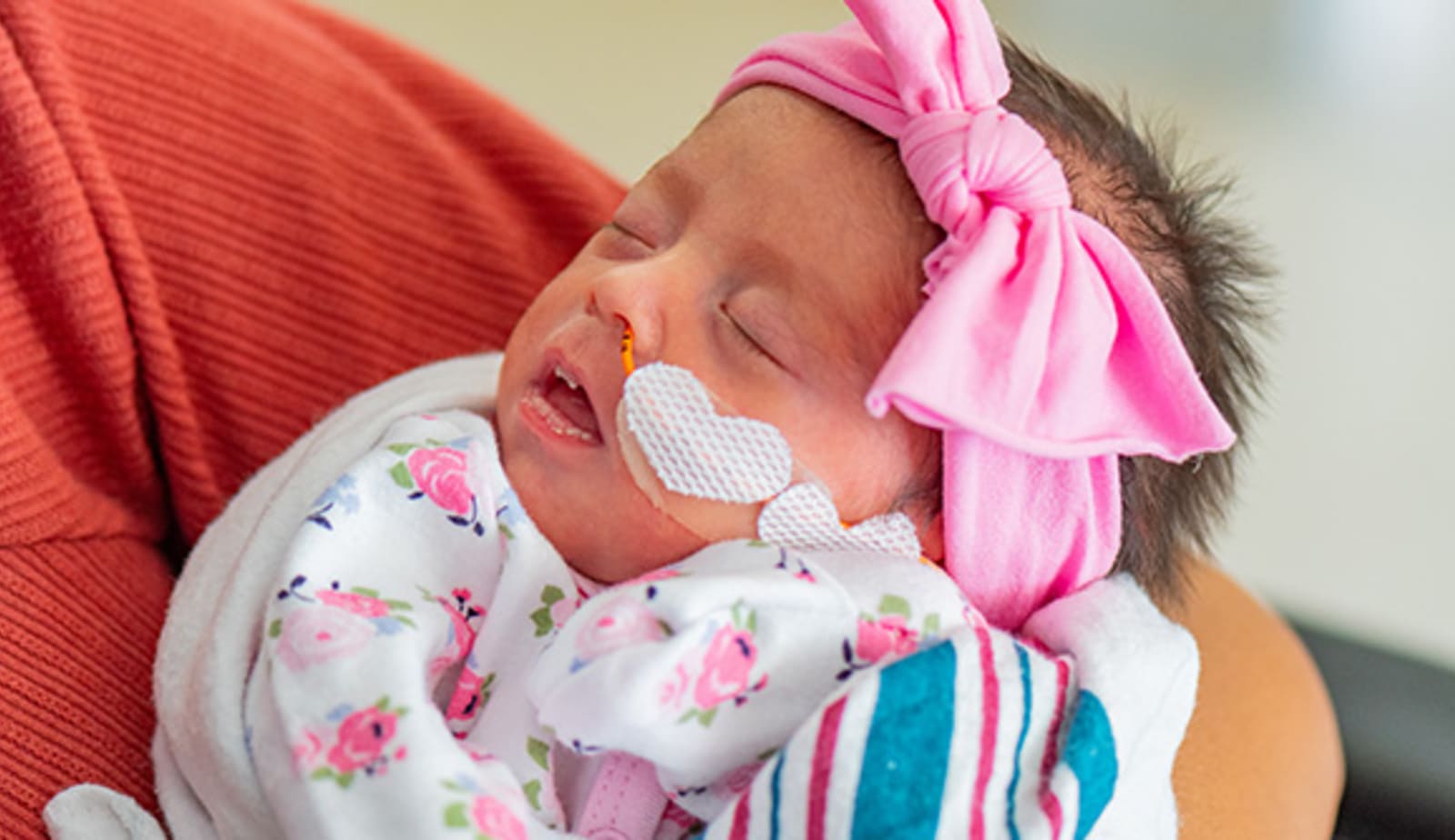
Preparing to give birth can be a stressful time. You’ve got your bags packed months in advance, family members are one call away, your home is babyproofed and you’ve stocked up on all the household essentials. Just when you think you’ve got everything ready for the baby’s arrival, your little one decides to make his or her grand debut early.
Most parents-to-be don’t want to think about the possibility of their child being born early, but the reality is that premature births are increasing.
That said, many babies are admitted into NICUs for other reasons, too.
Tiny but mighty
Reasons for admission to a NICU include:
- Preterm birth
- Birth defects
- Breathing and feeding problems
- Infections
- Other medical conditions
Conditions that require a newborn to receive extra care include:
- Respiratory distress syndrome (RDS)
- Pneumonia
- Anemia
- Apnea
- Hypoglycemia
- Jaundice
- Sepsis
The earlier a baby is born, the higher the chance of infection because his or her immature immune system can’t fight it off.
Though many conditions may require around-the-clock intensive care, prematurity is the most common. These babies aren’t fully developed enough to transition into the outside environment. Instead, in the NICU, they remain in a controlled, enclosed setting that mimics the environment of their mother’s womb.
“A birth is considered ‘preterm’ when a baby is born before 37 weeks of pregnancy have been completed,” said Jennifer Southall, RN, director of perinatal services at Wolfson Children’s Hospital and Baptist Medical Center Jacksonville.
Luckily, medical research and advances have allowed premature babies to have higher rates of survival and healthier lives. If parents know their unborn baby has an underlying medical condition and will be born needing critical care, they can connect with specialists before birth to develop a treatment plan.
Wolfson Children’s Hospital’s main NICUs provide comprehensive care to a wide range of patients, ranging from those who just need a little more time to mature to those with complex, life-threatening conditions who require lifelong care. The three-floor Neonatal Intensive Care Center in the Borowy Family Children’s Critical Care Tower provides the highest level (IV) of neonatal care, while also catering to children with simpler needs. This specialized care includes surgery for birth defects and access to a full team of pediatric subspecialists for the most medically complex situations.
The Wolfson Children's NICU at Baptist Medical Center South is level III, which means the team provides around-the-clock intensive care, like breathing support, for babies born as early as 28 weeks. The level II NICU at Baptist Medical Center Clay provides specialized monitoring and treatment for babies who need a little extra support after birth, such as those born moderately early or needing intravenous (IV) medications. If a baby in the Baptist South or Baptist Clay NICU needs higher-level care, families have seamless access to the level IV NICU in the Wolfson Children's Borowy Family Children's Critical Care Tower.
Life after NICU
A baby may be discharged from the NICU if he or she meets the following criteria:
- Maintains body temperature in an open crib for at least 24-48 hours without any supplemental heat
- Takes all feedings by bottle or breast without supplemental tube feedings (exception for those who require gastronomy tube feedings)
- Is able to gain weight steadily.
If your infant is born with a serious illness or is preterm, he or she may be admitted to Wolfson Children’s NICU for specialized medical care. There, the health care team provides high-level, coordinated care for your infant, along with support for your family. To learn more about the lifesaving care provided to newborns in the new Neonatal Intensive Care Center in the Borowy Family Children’s Critical Care Tower, visit wolfsonchildrens.com/tower.